Websites for licensed trades
If your site collects a phone number, somebody reviews it before you can text anyone.
Every agent, lender and clinic now wants to text leads from their own website. Before a carrier will let you, your site is checked by a person, and most sites fail on things that take an afternoon to fix. This is what that review looks at, and what we build so it passes the first time.
The four pages a registration fails without
To send business text messages in the United States you register the number for A2P 10DLC, and the carrier reviews the website attached to it. A site running a lead form that collects a phone number, with no privacy policy behind it, is the combination that gets rejected.
Four pages have to exist and be reachable: a privacy policy, terms of use, SMS terms, and a service disclaimer. We have watched a real brokerage site run a phone-collecting form with all four returning 404. It had been live for months. Nobody tells you, you simply never get approved.
The consent box, and why the obvious wording fails
Almost every site writes some version of “by submitting, you agree to be contacted.” That is implied blanket consent attached to the submit button, and it is the single most common reason a registration comes back rejected.
What a review expects instead is a consent that can be declined without losing the enquiry: either an optional phone field with no checkbox, or a required phone field with a genuinely optional checkbox, unchecked by default, with its own wording. Someone who will not consent to texts should still be able to send you a message.
And the answer has to be recorded. If you cannot show what a given person agreed to and when, you have a consent policy rather than consent.
What has to appear on every page, not just the footer
Each licensed trade carries its own identifiers, and they belong wherever the work is described rather than buried once at the bottom.
Real estate: the agent’s licence number, the brokerage name as the commission holds it, and Equal Housing Opportunity. Mortgage: the originator’s own NMLS number and Equal Housing Lender. Clinical: the treating clinician’s credential and licence, and “individual results vary” wherever an outcome is described. Contracting: the licence number wherever the state requires one.
Then there is the copy itself
A site can pass every check above and still be the thing that costs you. Fair Housing applies to your website exactly as it applies to a listing, and the phrases that breach it are the warm ones people reach for without thinking: safe neighborhood, family-friendly, great schools, perfect for a young couple.
Every page we build is read against your industry’s rulebook before it goes up, and so is everything you publish afterwards. That is 509 refused phrases across nine rulebooks, 282 of them in real estate alone, and they are published in full so you can read what we work to.
And it has to be readable by the thing people now ask
The same build is structured so an assistant answering “who should I hire” can actually read you: your services, your area, your credentials and your reviews as data rather than as pictures of text. Run the twelve checks on your current site and see what one can read today.
What one actually looks like
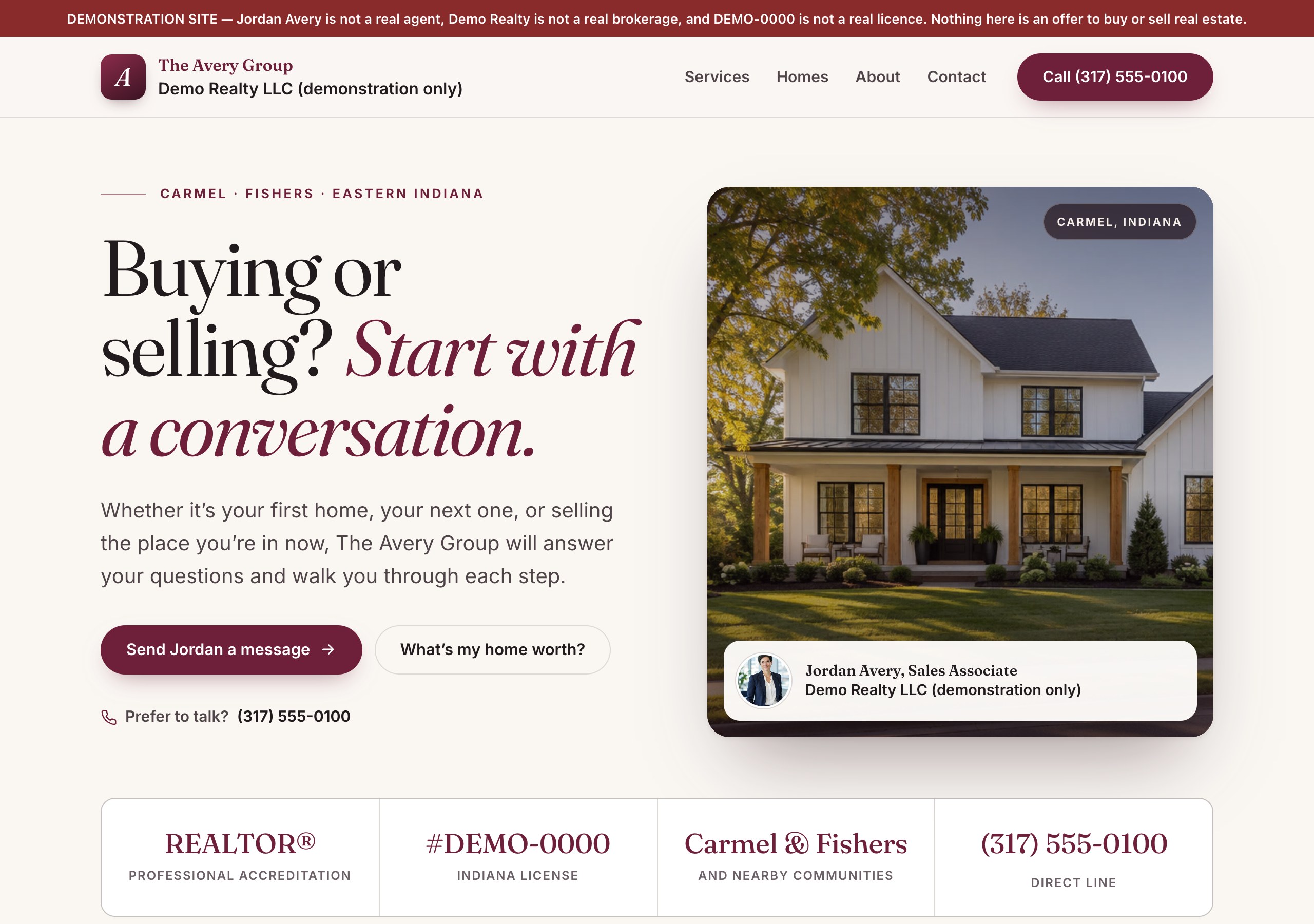
Below is a site built this way. The agent is invented and the brokerage does not exist, because a demonstration site should not borrow a real person’s licence, but every page, every identifier and every legal page is exactly what a real build ships with.
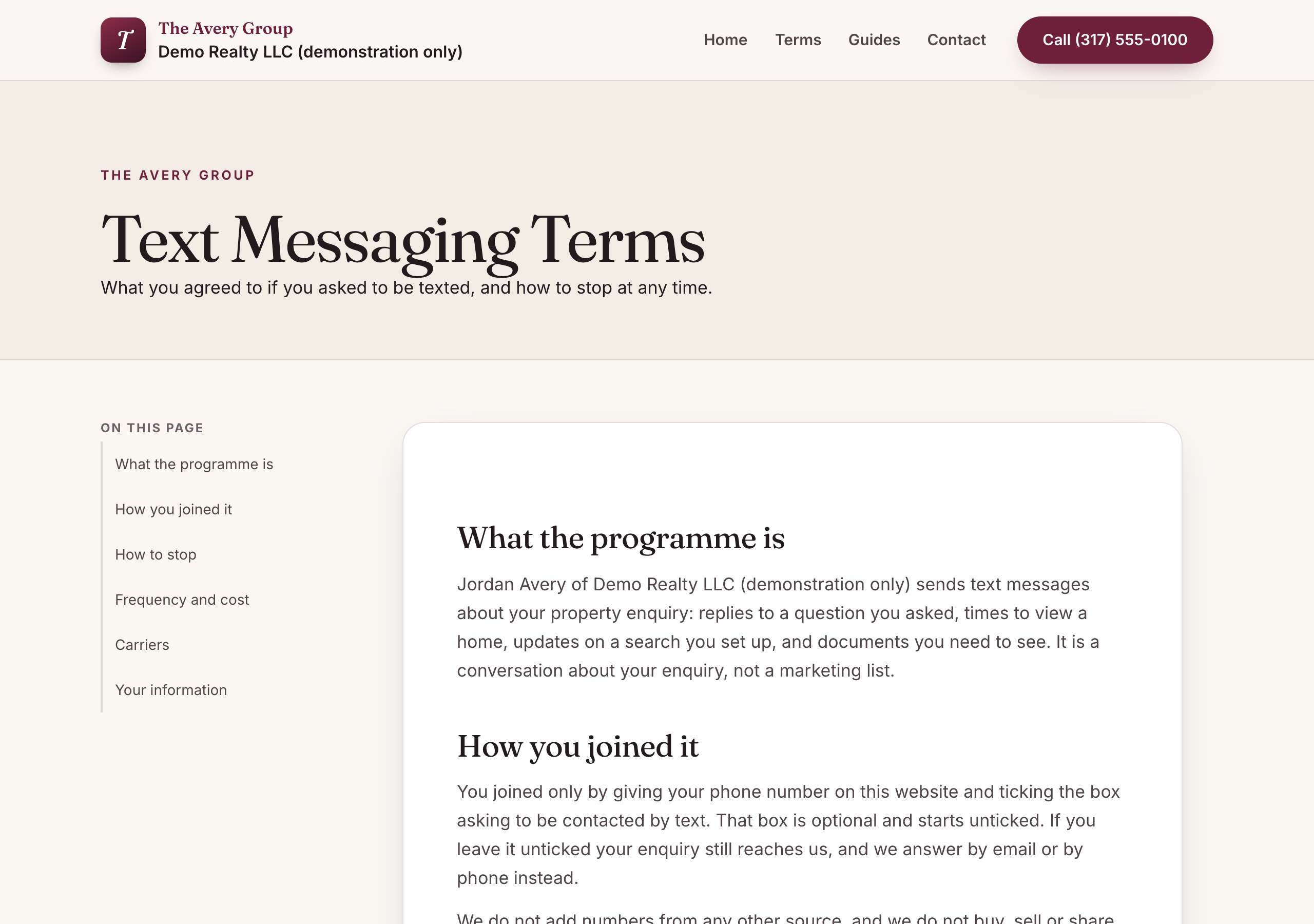
And this is the page almost nobody builds, which is the one that decides whether you can text anyone at all:
What it costs
$499 to build, then $99 a month. That includes the four legal pages written for your trade, the consent capture, the identifiers, the gate on every page and on everything you publish after, and a dated record of what was checked.
A screening tool and a build standard, not legal advice. Your broker, compliance officer or attorney has the last word, and a carrier makes its own decision.